Computer network
A computer network or data network is a telecommunications network that allows computers to exchange data. In computer networks, networked computing devices pass data to each other along data connections. The connections (network links) between nodes are established using either cable media or wireless media. The best-known computer network is the Internet.Network computer devices that originate, route and terminate the data are called network nodes. Nodes can include hosts such as personal computers, phones,servers as well as networking hardware. Two such devices are said to be networked together when one device is able to exchange information with the other device, whether or not they have a direct connection to each other.Computer networks support applications such as access to the World Wide Web, shared use of application and storage servers, printers, and fax machines, and use of email and instant messaging applications. Computer networks differ in the physical media used to transmit their signals, the communications protocols to organize network traffic, the network's size, topology and organizational intent.
A computer network or data network is a telecommunications network that allows computers to exchange data. In computer networks, networked computing devices pass data to each other along data connections. The connections (network links) between nodes are established using either cable media or wireless media. The best-known computer network is the Internet.Network computer devices that originate, route and terminate the data are called network nodes. Nodes can include hosts such as personal computers, phones,servers as well as networking hardware. Two such devices are said to be networked together when one device is able to exchange information with the other device, whether or not they have a direct connection to each other.Computer networks support applications such as access to the World Wide Web, shared use of application and storage servers, printers, and fax machines, and use of email and instant messaging applications. Computer networks differ in the physical media used to transmit their signals, the communications protocols to organize network traffic, the network's size, topology and organizational intent.

Wired communication refers to the transmission of data over a wire-based communication technology. Examples includetelephone networks, cable television or internet access, and fiber-optic communication. Also waveguide (electromagnetism), used for high-power applications, is considered as wired line.
- Twisted pair wire is the most widely used medium for all telecommunication. Twisted-pair cabling consist of copper wires that are twisted into pairs. Ordinary telephone wires consist of two insulated copper wires twisted into pairs. Computer network cabling (wired Ethernetas defined by IEEE 802.3) consists of 4 pairs of copper cabling that can be utilized for both voice and data transmission. The use of two wires twisted together helps to reduce crosstalkand electromagnetic induction. The transmission speed ranges from 2 million bits per second to 10 billion bits per second. Twisted pair cabling comes in two forms: unshielded twisted pair (UTP) and shielded twisted-pair (STP). Each form comes in several category ratings, designed for use in various scenarios.

- Coaxial cable is widely used for cable television systems, office buildings, and other work-sites for local area networks. The cables consist of copper or aluminum wire surrounded by an insulating layer (typically a flexible material with a high dielectric constant), which itself is surrounded by a conductive layer. The insulation helps minimize interference and distortion. Transmission speed ranges from 200 million bits per second to more than 500 million bits per second.
- An optical fiber is a glass fiber. It carries pulses of light that represent data. Some advantages of optical fibers over metal wires are very low transmission loss and immunity from electrical interference. Optical fibers can simultaneously carry multiple wavelengths of light, which greatly increases the rate that data can be sent, and helps enable data rates of up to trillions of bits per second. Optic fibers can be used for long runs of cable carrying very high data rates, and are used forundersea cables to interconnect continents.

Wireless communication is the transfer of information between two or more points that are not connected by an electrical conductor.
- Terrestrial microwave – Terrestrial microwave communication uses Earth-based transmitters and receivers resembling satellite dishes. Terrestrial microwaves are in the low-gigahertz range, which limits all communications to line-of-sight. Relay stations are spaced approximately 48 km (30 mi) apart.
- Communications satellites – Satellites communicate via microwave radio waves, which are not deflected by the Earth's atmosphere. The satellites are stationed in space, typically in geosynchronous orbit 35,400 km (22,000 mi) above the equator. These Earth-orbiting systems are capable of receiving and relaying voice, data, and TV signals.
- Bluetooth is a wireless technology standard for exchanging data over short distances (using short-wavelength UHF radio waves in the ISM band from 2.4 to 2.485 GHz[2]) from fixed and mobile devices, and building personal area networks (PANs). Invented by telecom vendor Ericsson in 1994,[3] it was originally conceived as a wireless alternative to RS-232 data cables. It can connect several devices, overcoming problems of synchronization.

- Infrared (IR) is electromagnetic radiation with longer wavelengths than those ofvisible light, extending from the nominal red edge of the visible spectrum at 700nanometers (nm) to 1 mm. This range of wavelengths corresponds to a frequencyrange of approximately 430 THz down to 300 GHz.[1] Most of the thermal radiationemitted by objects near room temperature is infrared.Infrared radiation was discovered in 1800 by astronomer William Herschel, who discovered a type of invisible radiation in the spectrum beyond red light, by means of its effect upon a thermometer. Slightly more than half of the total energy from the Sun was eventually found to arrive on Earth in the form of infrared. The balance between absorbed and emitted infrared radiation has a critical effect on Earth'sclimate.
communication protocols
communications protocol is a system of digital rules for data exchange within or between computers.
- TCP/IP-The Transmission Control Protocol (TCP) is one of the core protocols of theInternet protocol suite (IP), and is so common that the entire suite is often called TCP/IP. TCP provides reliable, ordered and error-checked delivery of a stream of octets between programs running on computers connected to a local area network, intranet or the public Internet. It resides at the transport layer.

- SMTP-Simple Mail Transfer Protocol (SMTP) is an Internet standard for electronic mail (e-mail) transmission. First defined by RFC 821 in 1982, it was last updated in 2008 with the Extended SMTP additions by RFC 5321 - which is the protocol in widespread use today.

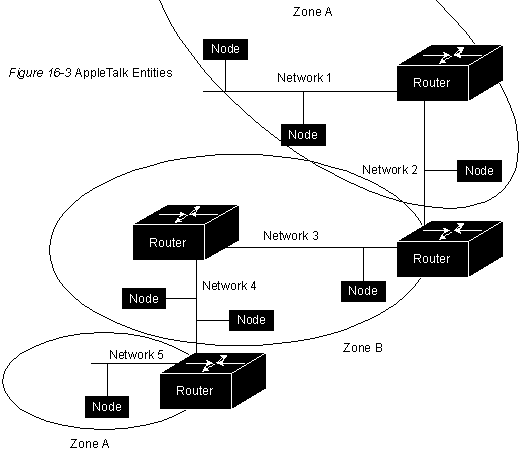
- AppleTalk is a proprietary suite of networking protocols developed by Apple Inc. for their Macintosh computers. AppleTalk included a number of features that allowed local area networks to be connected with no prior setup or the need for a centralized router or server of any sort. Connecting together AppleTalk equipped systems would automatically assign addresses, update the distributed namespace, and configure any required inter-networking routing. It was a plug-n-playsystem.
- NetBEUI was a protocol that 3com & Microsoft had developed for use in networked products such as Lan Manager. One of the biggest shortcomings in the NetBEUI protocol is that it can not be routed, as it has no concept of networks. Thus any large networks will have to be bridged and end up being too 'talky' and are unreasonable.


No comments:
Post a Comment